
Work with me

Three ways to fix the thing in the middle

Your executives and your marketing people are engaged in a game of tug-of-war where no one wins; arguing about what customers want, about what the money bought, about who's accountable for what. Every engagement I run puts something on that table that ends the fighting.

01 · Research

A common reality

Bad assumptions don't survive contact with what customers actually said.

02 · Planning

A blueprint

Effort and goals pointed the same direction, agreed before anyone spends.

03 · Fractional CMO

An experienced leader

Animosity replaced with accountability, by someone who's held both jobs.


I don’t sell “fixing the relationship” as a service, because it isn’t one. It’s what happens when the right thing is finally sitting on the table.

Service 01

Market Research

Puts a common reality in the middle of the table.

Ophea

Most marketing arguments are really arguments about assumptions. Your team believes one thing about why deals are won; sales believes another; nobody has asked the customer in eighteen months. Research ends that by putting what buyers actually said between you, and bad assumptions don't survive it.

This runs through Ophea, the market research company I founded. The interviews are AI-moderated, which is the part that makes the numbers work: when someone says something interesting, the next question follows it instead of marching on to item seven. You can run fifty real conversations that way. You cannot run fifty real conversations by hand.

Then a person reads them. Research design, the editing, the strategic call on what it all means, and the presentation at the end. That's me, and it isn't automated. The machine gets you the depth. The judgment is still a human problem.

What it's for

Win/loss on the deals you actually competed for. Customer experience on the relationships you already have. Market viability for the thing you haven't built yet.

How it's read

WALES™ scores each conversation 0–100 on what someone meant underneath what they said, how strongly they meant it, and what they're likely to do next.

What you get

A report with scored analysis, the themes, direct quotes, and recommendations in tiers.
Service 02

Marketing Planning

Puts a blueprint in the middle of the table.

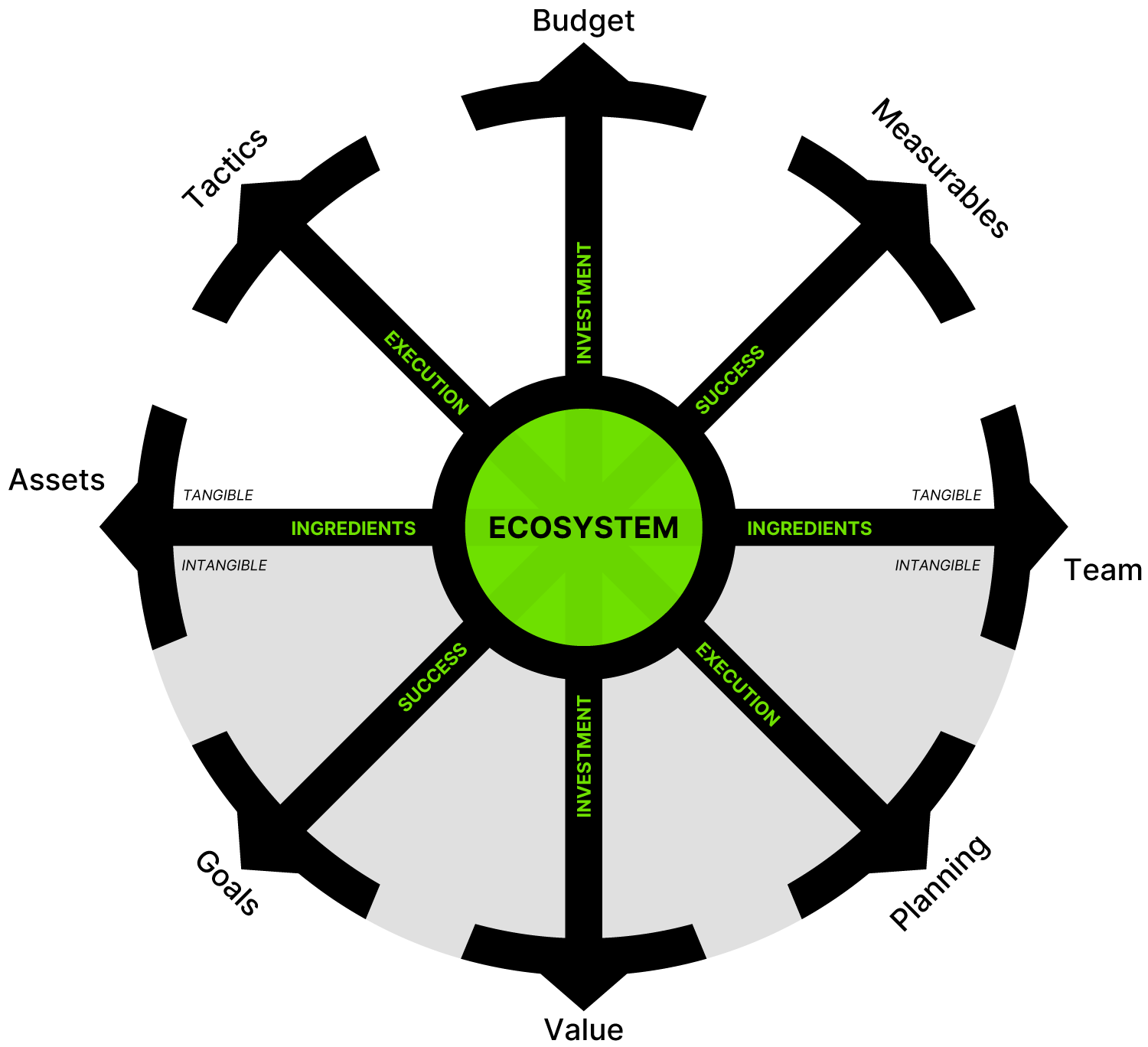
The Compass: Ecosystem at the centre, with Investment, Success, Ingredients and Execution radiating outward.

You're about to spend real money and nobody can tell you what it buys. That's not a budget problem; it's the absence of anything both sides have agreed to. A plan fixes it by being the thing you can both point at.

A fixed-scope engagement that produces one: built on The Compass, connecting your market to your budget to your goals to your tactics, with the measurement agreed before anyone spends anything. Once it exists, your marketing lead knows what winning looks like and you know what you're buying. The argument has somewhere to go.

This is still most of my work, and for most companies it's the cheapest way to find out whether the problem is the one they think it is.

The plan

Specific tactics, tied to specific goals, aimed at a specific stage of your buyer's journey.

The measures

LTV, CAC, Pipeline Assist Score and Marketing Influenced Revenue, agreed up front.

The owners

Who's accountable for what, and what authority they hold to actually deliver it.

Service 03

Fractional CMO

Limited Availability

Puts an experienced leader in the middle of the table.

Sometimes what's missing isn't information or a plan. It's that nobody in the room has done this before, so the conversation never gets past blame. I take the seat and the blame stops being the topic.

Strategy, budget ownership, team leadership, agency and vendor management, and a real presence in your leadership meetings, at a fraction of the cost and none of the ramp-up. I've been the marketer nobody trusted and the guy on the other side of the table, which means I can translate in both directions and I'm not intimidated by either one.

I hold very few of these at a time, because the job only works if I'm actually there. If there's no room when you ask, I'll say so on the call rather than stringing you along, and we'll find another way in.

What changes

Marketing gets goals it can control, and authority to match the accountability.

What you get back

A leadership meeting where marketing can answer the revenue question without flinching.

Questions

The things people ask first

Is the research done by AI or by people?

Both, and I'd rather be straight about which is which. Most interviews and research we conduct is AI-moderated, which is what makes our process uniquely efficient and scalable. The research design, the editing, the analysis and the presentation belong to me and my team. The innovative way we approach this means that Ophea's research is faster, cheaper, and more consistent than traditional methods.

Do you do the marketing, or just advise?

I lead, plan and hold people accountable. I don't run your ads or write your emails. You have people or agencies for that, and if you don't, part of my job is helping you choose them well. Where I earn my money is making sure the right work gets chosen in the first place.

We don't have a marketing person. Does any of this still apply?

Yes, and often more cleanly, because there's no existing relationship to repair. Planning tells you what to hire for before you hire, which is the opposite of the usual order and considerably cheaper than the usual order.

How quickly can we start?

Research engagements can often be kicked off within a few days and marketing planning projects within a couple of weeks. Timing for fractional CMO engagements depends on whether I have a seat open for that. Ask me about any of this and I'll tell you honestly.

What does it cost?

Pricing for Ophea research projects is available on our website. For planning and fractional engagements, pricing depends entirely on scope and I'd rather quote you something real than publish a number that turns out to be wrong for you. A conversation is free, and I'll give you a range on the call.

Ophea pricing →
What if my marketing person is the problem?

Sometimes they are. More often they're a capable person in an impossible structure: no clear goals, no authority, and accountability for outcomes they don't control. I'll tell you which it is, and I'm not squeamish about either answer.

Not sure which one you need?
That’s the conversation.

Half an hour, no deck. I’ll tell you plainly whether I can help, including when the answer is no.

Book a conversation