
Assessment

The Revenue Leadership Assessment

Business leaders lose their way getting from point A to point B in marketing, and there are no trail maps to get them back on track. What they need is a compass, so I built one. This scores you against The Compass, the framework every engagement I run starts from and the one the book is built around. Twenty-five statements, about five minutes, and your findings appear on this page. Nothing is sent anywhere and I do not ask for your email.

The framework

You are about to put yourself on The Compass

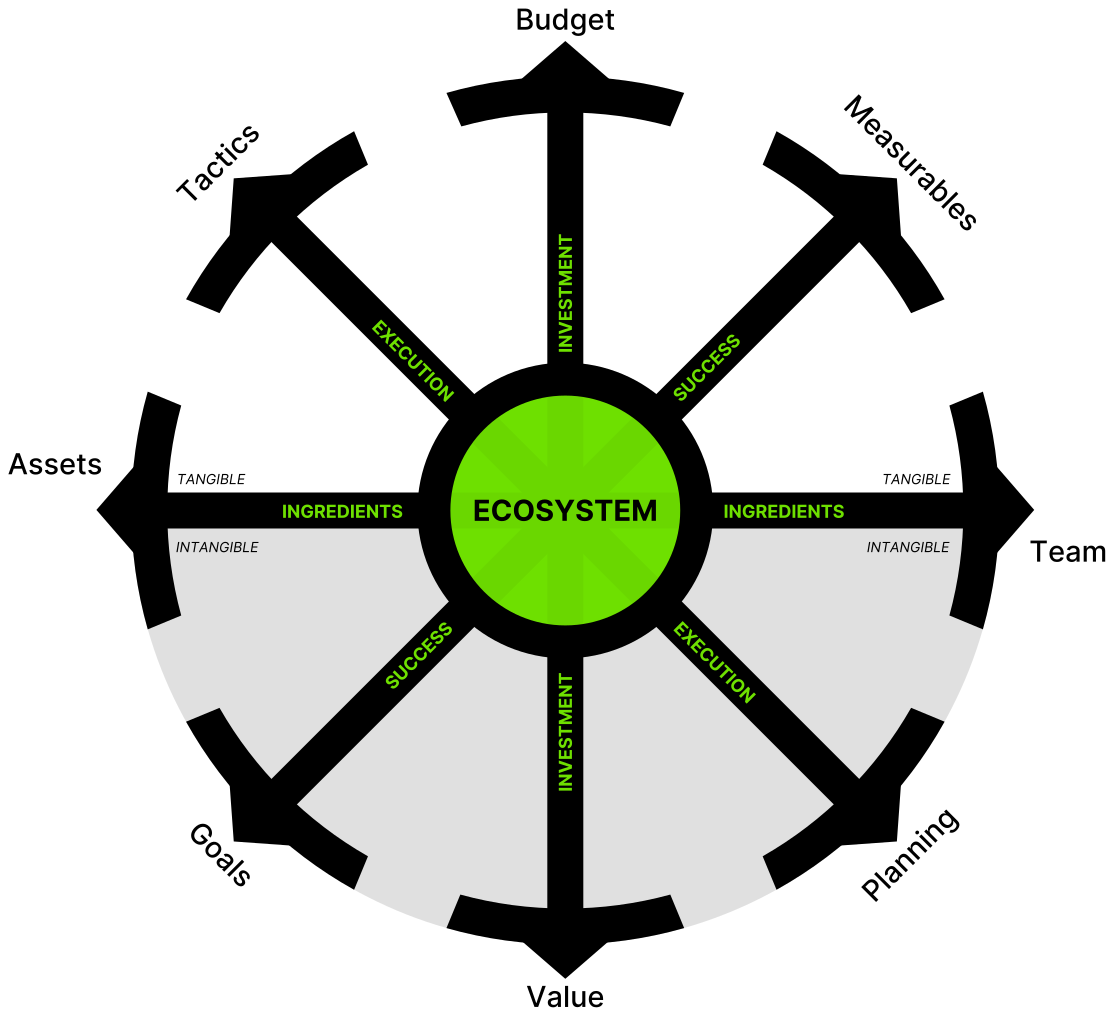
Every engagement I run starts from the same place. Ecosystem sits at the center: your customers, your competitors, and the real conditions your business has to survive. Four directions point outward from it, and each one has a tangible half you can see and an intangible half most companies never discuss. Miss one and the whole plan wobbles. The twenty-five statements below are those five things, five statements each.

The center

Ecosystem

Your customers, your competitors and the conditions your business actually has to survive. It has no tangible and intangible half because it is not a direction. It is the ground the other four are measured from, which is why it is the one worth getting right first.

Direction

Investment

BudgettangibleValueintangible

Direction

Success

MeasurablestangibleGoalsintangible

Direction

Ingredients

AssetstangibleTeamintangible

Direction

Execution

TacticstangiblePlanningintangible

The Revenue Leadership Compass: Ecosystem at the center with Investment, Success, Ingredients and Execution radiating outward, each split into tangible and intangible halves.
The Compass, as it appears in the book.

The center of The Compass

Ecosystem

This is where everything happens. It houses all of our customers, former, future and current, as well as our competitors, vendors, and even the economic and political climate we and our customers are trying to navigate. Everything we do has to interact with the ecosystem, and none of our efforts will bear fruit if they cannot survive the challenges that the real world and real customers present. Our ultimate success depends on how well we understand this ecosystem and the needs, problems and desires of the people living in it.

I conduct market research on an ongoing basis

I'm capable of being surprised by my marketplace and what my customers think about my business

My company's marketing is designed specifically to connect my customers' problems and aspirations with my product or service

My marketing materials speak to my customers in their language, not mine

I have documented profiles of my customers and specific standards on how to write content for them

Direction 1 of 4

Investment

BudgettangibleValueintangible

There is no getting around it: financials are critically important in marketing. But it is not just about the amount of money that is spent, it also refers to the value we get in return for that spend. Budget numbers are tangible. Value is not, and can be subjective. As department store owner John Wanamaker famously said more than 100 years ago, half the money he spent on advertising was wasted; the trouble was not knowing which half. Let's start connecting those dots.

When I spend money on marketing I know exactly what I'm going to get in return

My marketing budget is specifically designed to fund my growth goals

ROI is built into my marketing financial model

I know how much profit my next customer will be worth to my business

I know how much profit my company's brand creates

Direction 2 of 4

Success

MeasurablestangibleGoalsintangible

Understanding how we can lay the groundwork for success is crucial. The metrics are what is tangible here. The numbers might tell a story about revenue, brand awareness, customer satisfaction or various other things. But goals are often a lot fuzzier: unless we have context, our numbers are not able to tell us whether we are being successful. And without clear, common goals, all we get is confusion and mistrust.

If I asked everyone on my team what our business goals were for this quarter or this year, they would all say the same thing

Everyone involved in sales and marketing at my company measures success the same way

My company's goals are documented and shared, and are never changed without notifying my team

I have a dashboard that is updated at least monthly to track the most important metrics of success in marketing

My goals drive my decision-making in sales and marketing

Direction 3 of 4

Ingredients

AssetstangibleTeamintangible

Ingredients are the raw materials we use to drive revenue growth. On the tangible side, that includes the logo, the content, the marketing materials, sales proposals and the website: things we can easily see and interact with. On the other side is our team and the contributions of the people on it. Marketers tend to be less visible than their counterparts elsewhere. When someone in sales signs a new deal we celebrate and we pay commissions, but the marketing contributions that helped make the sale possible are often not celebrated as heartily.

I have brand standards for my company that are adhered to

I have a library of content, like blog posts, white papers, photos and case studies, that my team uses to build sales and marketing campaigns

Everyone involved in my company's marketing is fully accountable and meets my expectations of their role

My C-Suite, sales and marketing people work collaboratively and productively without any infighting

Everyone involved in my sales and marketing process has a clearly defined role, and we don't have people stepping on each other's toes

Direction 4 of 4

Execution

TacticstangiblePlanningintangible

Execution is where the rubber meets the road, and where tactics are tangible while planning is often unseen. We see the billboard, the direct mail, the email marketing and the social posts. But we often devalue the time it takes to plan those efforts to ensure we are doing the right thing. No one is granting wishes with the snap of a finger, and rushing into the part of the process where we produce stuff will often yield poor results.

When we invest in a specific marketing campaign or tactic, we have a high level of confidence that we're spending money wisely

My team manages marketing priorities effectively and we never get sidetracked by last-minute projects that feel urgent but aren't important

Everyone involved in my company's marketing is on the same page about what projects are being worked on and when they need to be done

We carefully choose our marketing campaigns and tactics based on the portion of the sales journey we need to influence

The tactics and campaigns we choose are based on studying the behaviors of our customers